
Marin County Parole vs Probation
Post-release supervision in Marin County is not one record system. Probation usually comes from a Marin Superior Court sentence or supervision order. It can start after a county jail term, after a court grants probation instead of more custody, or after a split sentence that includes mandatory supervision. Parole is different. State parole follows a release from the California Department of Corrections and Rehabilitation, and the statewide parole agency is the CDCR Division of Adult Parole Operations, often called DAPO.
PRCS, or Post-Release Community Supervision, sits between those ideas. Marin County Probation's Public Safety Realignment AB109 material says realignment shifted responsibility for some people historically supervised by CDCR to county probation departments. In Marin, that means a person released from prison may be supervised locally through Probation Adult Services rather than a DAPO parole unit. A person released from Marin County Jail by bail, time served, or court order does not become a parolee merely because they left custody.
| Supervision type | How it usually starts | Where to verify |
|---|---|---|
| County probation | Marin Superior Court sentence or probation order after a local case. | Marin Superior Court records and Marin County Probation. |
| Mandatory supervision | A county sentence with part served in custody and part supervised in the community. | Court minutes, sentencing order, and Marin County Probation. |
| PRCS | Release from prison to county supervision under AB109 for qualifying cases. | Marin County Probation Adult Services and related court or CDCR records. |
| State parole | Release from CDCR to DAPO supervision. | CDCR, DAPO regional parole units, and BPH records when hearings apply. |
Verify Marin County Post-Release Supervision
A released person may have several public traces, but no single public lookup replaces the supervising agency's own record. Start with the case history when the release grew out of a Marin court case. The court file can show probation terms, a sentence, a custody-credit ruling, a release order, or a later violation matter. Then move to the correct supervision office. Marin Probation is the local channel for county probation, mandatory supervision, and PRCS. DAPO is the state channel for parole from CDCR. California VINE can help with custody-change notice, but it does not prove the terms, officer assignment, or discharge status.
- Check the Marin Superior Court case for the sentence, probation order, custody credits, or later violation proceeding.
- Use Marin County Probation when the record points to county probation, mandatory supervision, AB109, or PRCS.
- Use CDCR and DAPO when the person was released from state prison or the record shows state parole.
- Review BPH schedules or results when a life term, parole-suitability hearing, or parole grant is part of the state-prison record.
- Use California VINE only as a custody-change notification layer, then reconcile the alert with court, probation, CDCR, or Sheriff records.
Marin County Jail release facts and post-release supervision facts should stay separate. The jail record answers whether the person left the jail, when that local custody event occurred, and sometimes the manner of release. The supervision record answers what agency has authority after release, what type of supervision applies, and whether a discharge, violation, or warrant changed the status. For the local release record itself, the broader Marin County released inmate search path starts with the Sheriff's booking and records channels on the Marin County released inmates home page.
Marin County Probation Release Office
Marin's local supervision source is concrete. The AB109 page lists Probation Adult Services at the Civic Center address in San Rafael and identifies the unit as the local channel for PRCS work. That office is the better starting point when a release record refers to county probation, PRCS, mandatory supervision, or a locally supervised jail sentence. It is not the statewide parole board, and it is not the Sheriff's booking-record unit.
Marin County Probation Adult Services
3501 Civic Center Drive, Suite 265
San Rafael, CA 94903
415-473-6599
Monday through Friday, 8:00 a.m. to 4:00 p.m.
CDCR DAPO Headquarters
State parole supervision agency for CDCR parole cases.
279-223-3800
The AB109 material also names Marin's Coordination of Probation Enforcement unit, or COPE. COPE focuses on monitoring high-risk narcotics violators placed on probation rather than serving time in custody. That makes COPE useful local context for supervision enforcement, but not a general released-inmate locator. A caller trying to confirm supervision should first know whether the case is county probation, PRCS, or state parole.
Marin County Parole Hearing Records
State parole can involve DAPO supervision, BPH hearing material, or both. The California Board of Parole Hearings is within CDCR and handles parole-suitability hearings for eligible state-prison cases. Marin County does not run those hearings. If a Marin case resulted in a CDCR life term or another parole-eligible state-prison term, the BPH schedule and results systems are the hearing channels, while Marin Superior Court remains the court-of-conviction channel.
BPH publishes hearing schedules with date, time, location, and whether the hearing is by video conference or in person. BPH schedule material is updated weekly on Thursday morning. BPH also publishes parole-suitability hearing results. Its result terms matter: a Grant means suitable and recommended for release to parole, subject to required review before finality; Deny means not suitable; Continue means the hearing started but was not completed; Cancelled means the hearing no longer needs to go forward.
The BPH parole eligibility material also defines EPRD and MEPD, terms that affect state-prison release timing. Those terms do not replace a Marin County Jail release date. They apply to CDCR sentence and parole-eligibility records. For a court sentence that includes a release-date question, the separate Marin County inmate release date page covers jail credits, CDCR credits, EPRD, MEPD, detainers, and court-order changes.
A captured source screenshot comes from CDCR's Northern Region directory. The Northern Region parole units page helps show why Marin state parole should be verified through DAPO or CDCR, not guessed from residence alone.
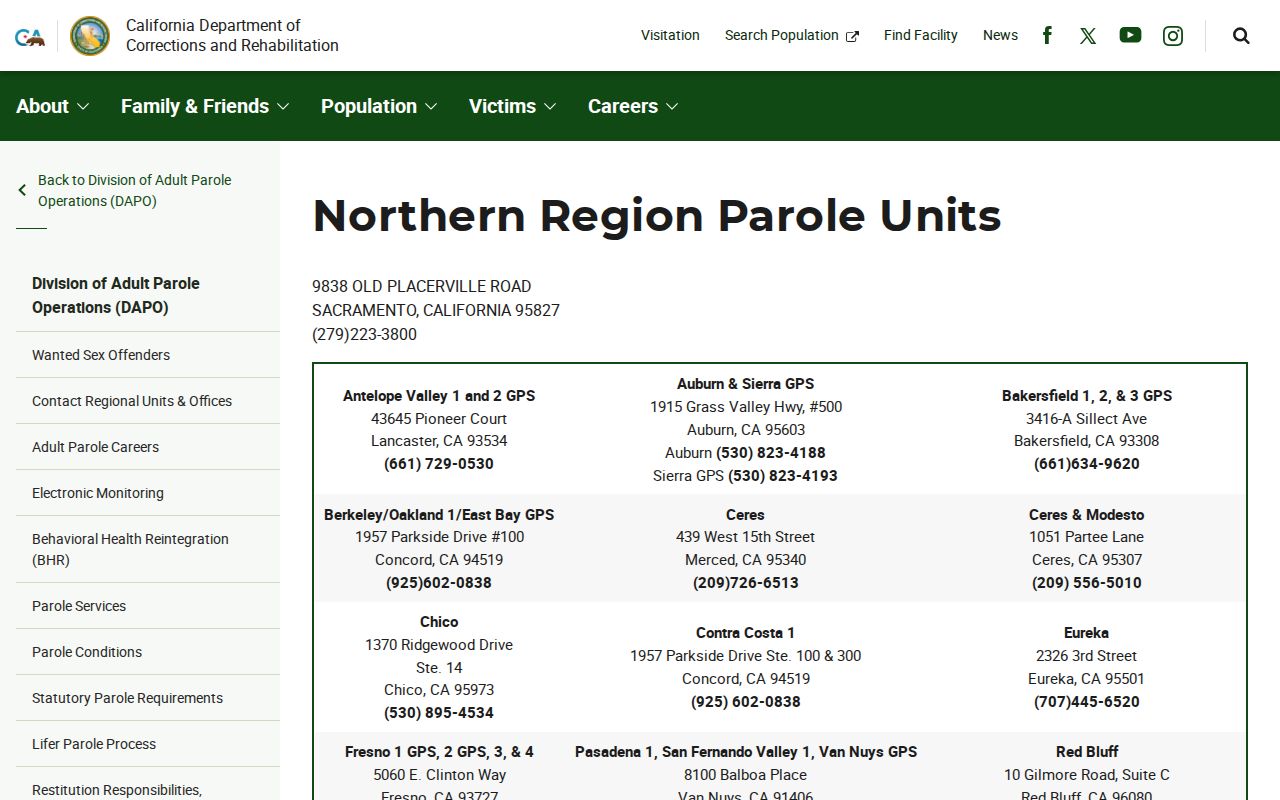
Marin may be closest to several Northern Region units, including San Francisco, Santa Rosa, Vallejo/Woodland, and East Bay options, so the actual supervising unit should be confirmed through DAPO or CDCR.
Marin County Parole Warrant Limits
Absconder is a supervision term for a person who is alleged to have stopped reporting or cannot be located as required. A warrant or violation can flow from court probation, county supervision, or state parole, but the public path depends on the category. No general Marin County absconder list was located in the reviewed official sources. That gap matters. A public reader should not treat one state parole tipline as a countywide warrant search.
DAPO does maintain a wanted sex offender and tipline page for the specific state parole category it covers. That page instructs people to call local law enforcement for emergencies and provides CDCRDAPOTIPLINE@CDCR.CA.GOV for tips about persons on that list. Use that channel only for the narrow DAPO wanted-sex-offender context. For a Marin probation violation, check the court docket and Marin Probation. For a new arrest or local jail hold, use current custody channels first.
- Parole
- State supervision after release from CDCR, normally handled through DAPO.
- Probation
- Community supervision ordered by the court, often handled locally through county probation.
- PRCS
- Post-Release Community Supervision for qualifying prison releases supervised by the county under AB109.
- Absconder
- A supervision term for a person alleged to be unavailable or not reporting as required.
Note: A VINE release alert can help confirm a custody event, but the supervising agency confirms the supervision status.
Marin County Release Property Checks
Release is often followed by practical records steps. Marin Sheriff's Records material says valid ID must be seen before release of information, which can affect in-person booking-record pickup and some property questions. The same Records FAQ separates evidence property from other property. Evidence property requires authorization from the Marin County District Attorney's Office. Other property requires contact with the Sheriff's Property Clerk and an appointment.
This is not a supervision lookup, but it often intersects with probation and parole verification. A person leaving jail may need court minutes, valid ID, property pickup instructions, and a probation or PRCS reporting direction. A state parolee may need DAPO reporting instructions instead. Keeping those lanes separate reduces the chance of asking Marin Probation for a Sheriff's booking record or asking the Sheriff's Records Division to confirm DAPO parole conditions.
| Booking or release record | Use Marin Sheriff's Records Division for local booking records and release facts. |
|---|---|
| Evidence property | Requires authorization from the Marin County District Attorney's Office before release. |
| Other property | Contact the Sheriff's Property Clerk at 415-473-6820 and make an appointment. |
| Supervision reporting | Use Marin Probation for local supervision or DAPO for CDCR parole. |
Marin County Supervision Discharge
Supervision ends through the authority that created it. A probation case may end by court order, completion of the probation term, termination, dismissal relief, or a later violation ruling. A PRCS case is handled through county supervision rules and related court or probation records. A CDCR parole case runs through DAPO and, for parole-suitability matters, BPH records may explain the hearing history that led to release.
Discharge is not the same as the original jail release. A person can be released from Marin County Jail and still have probation, PRCS, parole, court dates, or property steps to resolve. They can also be discharged from supervision long after the jail release record has aged out of the current booking log. Confirm the jail release through Sheriff Records or court minutes, then confirm the later supervision status through Probation, DAPO, BPH, or the court channel that fits the case.