
Marin County Scheduled Release Dates
A scheduled or projected date is an expected release point based on the current sentence, credits, and custody record. It is not the same as the actual release event. The actual event occurs only after the jail, court, CDCR institution, or receiving agency completes the required release steps. In Marin County, that distinction matters because a person held at Marin County Jail may be released by bail, time served, a court order, probation placement, transfer, or another agency handoff, while a person in CDCR custody has a state-prison release workflow.
Pretrial detainees usually do not have a true release date. Their custody status can change when bail posts, charges change, the court issues a release order, another warrant clears, or the case resolves. A sentenced jail inmate may have a more defined end point, but credits and court minutes still control. A CDCR prisoner may have public state terms such as EPRD or MEPD, yet those terms are not a Marin County Jail field.
Marin County Jail vs CDCR Dates
The safest way to find a Marin County inmate release date is to identify the custody system first. Marin County Jail is a county jail. It is not a state prison, and a person who simply leaves Marin County Jail does not automatically appear in CDCR's public CIRIS search. The local jail record answers whether the person left county custody and may show the time and manner of release. The Marin Superior Court record can show the sentence, custody credits, bail, release order, dismissal, or probation terms that drove that release.
CDCR records answer a different question. They apply when a person was sentenced or transferred to state prison, released from CDCR, or supervised after release through CDCR parole or county PRCS. CIRIS, the California Incarcerated Records and Information Search, is the public state search at ciris.mt.cdcr.ca.gov. CA.gov describes CIRIS result fields as name, CDCR number, age, current location, commitment counties, admission date, and Board of Parole Hearing dates and outcomes for persons currently in CDCR custody.
| Release-date question | Best Marin channel | What it can show |
|---|---|---|
| Did the person leave Marin County Jail? | Sheriff booking and Records Division records. | Local release date, time, manner, and booking details when public. |
| What court order changed custody? | Marin Superior Court ePortal or Court Records Division. | Release order, sentence, custody credits, probation, dismissal, or next hearing. |
| What is the state-prison release term? | CDCR CIRIS and BPH records. | CDCR number, location, admission, BPH dates and outcomes, EPRD or MEPD context. |
| Will a status change trigger notice? | California VINE when the record is available. | Custody-change alert, release alert, transfer notice, or return-to-custody notice. |
Find a Marin County Release Date
Release-date research should move from local to state only when the facts call for it. A current or very recent jail stay begins with the Marin Public Booking Log, but that log is a current-custody and recent-booking tool, not a released-person archive. If the person is missing from the current log, do not assume release. Use records, court, VINE, CDCR, BOP, or ICE based on where custody went.
- Search the Marin Public Booking Log while the jail stay may still be active or very recent.
- If the name is gone, request the local booking or release record from the Sheriff's Records Division.
- Check Marin Superior Court for sentencing, custody credits, release orders, probation, dismissal, or a warrant issue.
- Use CIRIS only when the person was sent to CDCR, released from CDCR, or tied to state parole or PRCS.
- Register in California VINE for notice if the person is still in a covered custody record and release timing is uncertain.
- Use BOP or ICE only when the facts show federal prison or immigration custody, not as a substitute for a Marin jail record.
CDCR's public contact material directs people who need CIRIS access or viewing help to the Identification Unit at 916-445-6713 during weekday business hours. For a Marin jail record, the local Records Division remains separate. The county release search path on the Marin County released inmates home page gives the broader route for booking records, court records, and custody transfers.
Marin County EPRD and MEPD
California's official state-prison release terminology comes from BPH and CDCR material. The Board of Parole Hearings defines Earliest Possible Release Date, or EPRD, as the date a determinately sentenced person will be released based on the court-imposed sentence minus applicable credits. BPH defines Minimum Eligible Parole Date, or MEPD, as the date an indeterminately sentenced person, such as a life-with-possibility-of-parole prisoner, becomes eligible for parole consideration based on the sentence minus credits.
Those terms do not tell whether a person was released from Marin County Jail on a local case. They belong to the state-prison side of the record. For a Marin case that went to CDCR, they can help explain state timing, BPH hearing eligibility, and why a parole-suitability result may affect release. For a local jail case, the more relevant records are the Sheriff's booking/release record, the court sentence, and Penal Code 4019 custody-credit calculations where they apply.
A captured source screenshot supports the California Penal Code section 4019 discussion. The California Legislative Information page for Penal Code section 4019 is relevant because county jail credits can shorten local custody time in eligible cases.
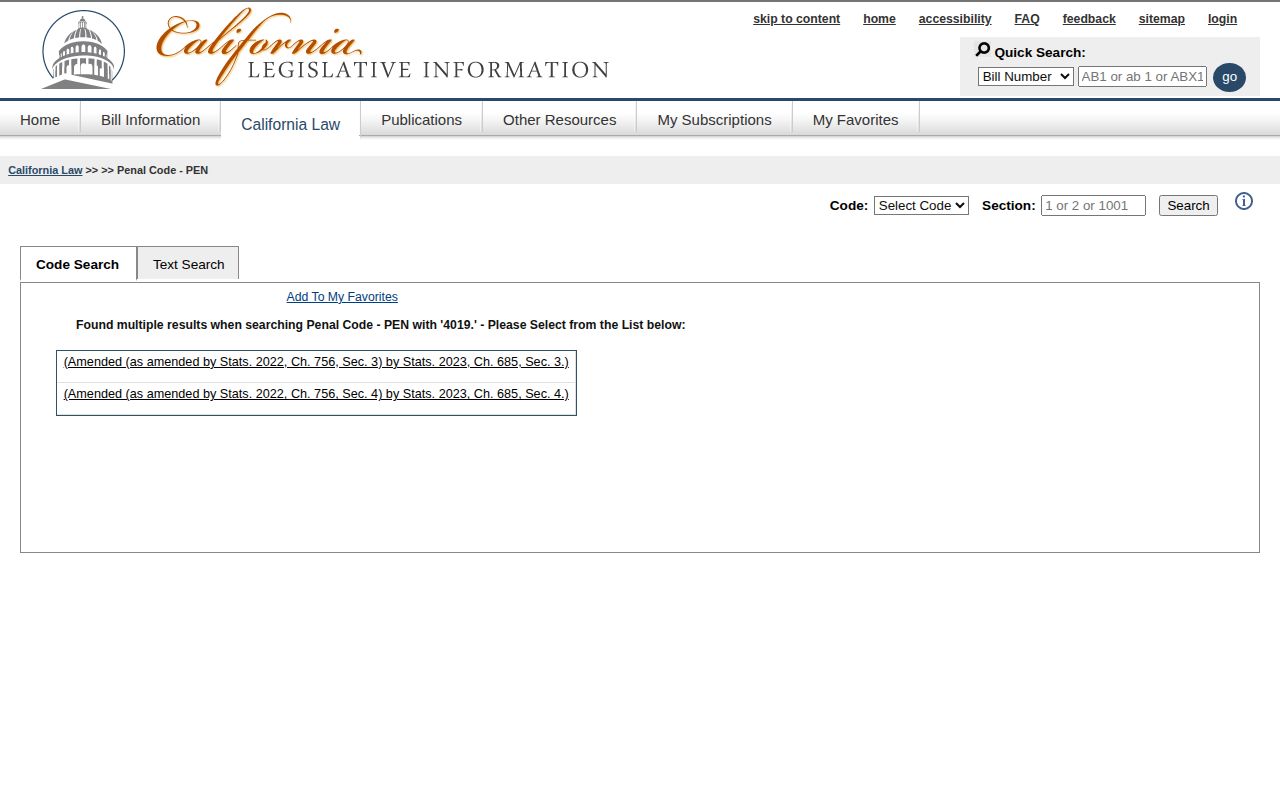
Use the statute as a credit framework, not a calculator. The court record and jail record control the actual Marin County release result.
Marin County Jail Credit Rules
Penal Code section 4019 governs county jail work-time and good-time credit categories for eligible jail confinement. In plain terms, credits can reduce the custody time a person must serve, but eligibility and calculation depend on the judgment, offense, custody category, and court records. Marin County Jail cannot be treated like a CDCR prison for this purpose. A local jail date can turn on actual days, conduct credits, court-applied custody credits, a time-served ruling, or a new court order.
CDCR credits are separate. CDCR describes Good Conduct Credit as credit for eligible people who comply with rules and perform assigned duties. CDCR's May 1, 2021 credit framework generally gives eligible people 33.3 percent credit for violent offenses or 50 percent for nonviolent offenses, with higher rates for some minimum-custody or fire-camp categories and exceptions. That public summary still does not allow a reliable outside calculation for one person. Classification, sentence type, offense, eligibility, and regulations all matter.
| Penal Code 4019 | County jail conduct or work credit framework for eligible local custody categories. |
|---|---|
| Penal Code 2933.1 | Credit cap source for certain violent felonies listed in Penal Code section 667.5(c). |
| CDCR Good Conduct Credit | State-prison credit system based on sentence, conduct, duties, classification, and eligibility. |
| Court custody credits | Credits applied or corrected through court minutes, judgments, resentencing, or amended orders. |
Note: Do not estimate a Marin County release date by subtracting a fixed percentage from the sentence; the official record controls.
Marin County 2933.1 Limits
The familiar "serve about 85 percent" phrase comes from credit limits such as Penal Code section 2933.1. That statute caps worktime credit at no more than 15 percent for people convicted of violent felony offenses listed in Penal Code section 667.5(c). It is a real rule, but it should not be used as a blanket formula for all California release dates.
California credit rules have changed over time and vary by offense, sentence, custody classification, and eligibility. Some sentences are governed by statutory caps. Others may earn different CDCR credit rates. Local jail credits under Penal Code 4019 are a separate county-custody calculation. The clean way to confirm a Marin County inmate release date is to use the actual court minutes, jail record, CIRIS result, or CDCR/BPH record rather than a rough public estimate.
A captured source screenshot is tied to section 2933.1. The published Penal Code section 2933.1 reference supports the violent-felony credit-cap caveat for state-prison and sentence-credit explanations.
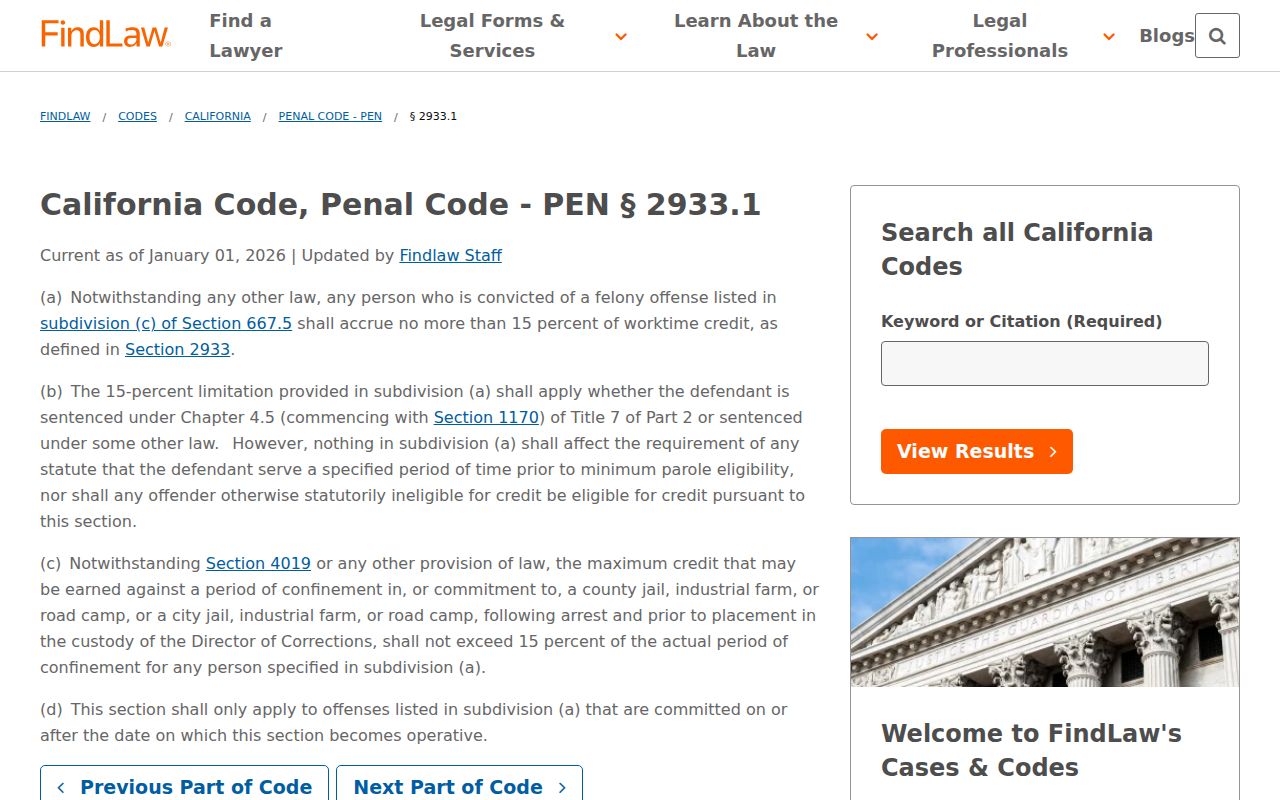
That credit cap is only one part of California release-date analysis, so the final date should be verified through the responsible agency record.
Why Marin County Dates Change
A changed release date is not always an error. CDCR release processing includes checking other cases, following up on detainers, assigning a parole or PRCS office, drafting parole conditions, processing specialized reviews, issuing required notices, and ensuring release funds. That means a court order, credit change, or resentencing event may need processing before a public release event appears. Local Marin County Jail dates can also change when bail posts, a warrant clears, another agency takes custody, or the court modifies an order.
| Factor | How it affects a date |
|---|---|
| Credits earned or forfeited | May move the expected date earlier or later based on conduct, eligibility, or court credit findings. |
| Detainers and holds | Can prevent release to the community if another agency has legal custody authority. |
| Court orders | Bail, dismissal, sentence changes, resentencing, or amended minutes can change local or state timing. |
| Supervision processing | CDCR may need to assign parole or PRCS, draft conditions, and issue required notices. |
| Transfer | Movement to CDCR, another jail, BOP, or ICE changes which system confirms the next date. |
Marin County Detainers and PRCS
Detainers, court holds, and supervision assignment can make a release date look confusing. A person may finish a Marin County Jail sentence but remain unavailable for community release because another warrant, agency hold, or transfer applies. A person released from CDCR may need DAPO parole or county PRCS processing before release is complete. Marin Probation's AB109 material makes PRCS a local factor for qualifying prison releases to county supervision.
Use the agency tied to the hold. A Marin court order should be checked with Marin Superior Court. A local booking/release record belongs with the Sheriff's Records Division. A CDCR state-prison release or DAPO parole assignment belongs with CDCR, DAPO, or BPH when a hearing is involved. California VINE can provide notice of a custody-status change, and the Marin County VINELink release check route can help with alerts, but VINE should still be reconciled with the official record that caused the release or hold.